
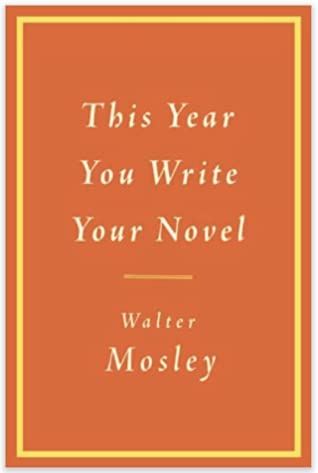
Amidst the Covid-19 shelter-in-place period, I picked up This Year You Write Your Novel by Walter Mosely.
It’s a small book, no more than 25,000 words he says. The advice in it is simple: write every day, tips on the writing processes (outlining or not), the elements of fiction, rewriting, and miscellany like publishing and work-shopping.
None of these are topics you won’t have seen touched on in other writing process books. But at times one needs to go back to basic advice. And I prefer to think simple advice followed, is superior to novel advice consumed and ignored.
I remember reading this book years before, back when I thought writing a first draft was writing. On this latest reading of Mosely’s advice, I most appreciated his chapter on revision.
I am currently working through rewrites on a novel. I relish first drafting, I enjoy outlining too. (Though, sometimes it feels like it’s a roadblock in front of drafting bliss). Editing, however, is that part that I am having to get to know and am fighting the urge to cringe-away from in search of my next first-draft high.
Mr. Mosely helped put the actual process into proper perspective: He portions revision a full 9 months in that 12-month writing year. God bless him! And I know it may not take that long for everyone, but that writing/rewriting ratio, 1:3, did provide a boost in encouragement.
The book is in narrative form, so I thought I would capture some of his tips for revision with my structural interpretation:
Summary:
- First draft: make it
- Second draft: read through making notes
- Decide approach
- The many drafts that follow: examine elements in every Idea, character, paragraph, sentence, and word
Elements:
- Nexus of character, story, theme, and plot
- Repetition
- Description
- Dialogue
- Prose
- Music
- Finish
Detailed:
- First draft: Create a first draft
- The production of daily set aside time for writing (he does 3 hours in the morning)
- Write a certain amount every day 600 – 1200 words
- Around three months’ time
- Second draft: Read entire first draft (pencil corrections allowed)
- He suggests around a week
- Make notes of problems
- Does the story engage you?
- Does the story make sense?
- Have you set up a pattern of revelation (the plot) that moves the story along?
- Is there any discernible change in the main character(s)?
- And how do the ideas that manifested themselves in the second draft affect how you see the story now?
- Use paper for notes lists, internal schedules, and longer insertions
- Important: Decide if the novel is worth the next 9 months of your life. Does it have soul or not?
- Decide your approach:
- Option a: Start at page 1 and fix everything you see.
- Option b: Go through the novel make only certain kinds of changes. Make notes on other issues.
- The many drafts that follow: Depending on what approach you choose you get to look for different elements (described below) at various levels of scale within the novel.
“Now you have to go through your book idea by idea, character by character, chapter by chapter, paragraph by paragraph, sentence by sentence, and finally even word by word, submitting it to many, many levels of analysis and critique.”
–This Year You Write Your Novel by Walter Mosley, p 104
Rewriting Elements:
- The nexus of character, story, theme, and plot
- He doesn’t describe this, but offers an example of how he would approach it in a book.
- Repetition
- Cut extraneous words and phrases first
- Utilize repetition to draw attention to something, have a reason for it
- Description and condensation
- Similar to repetition: make it purposeful
- You can’t show everything, be selective “The only details that should be put in any description are those that advance the story or our understanding of the character” (p 114)
- Most writers tend to overwrite. Avoid over-describing, using too many words in the same sentence particularly in the same sentence. Present your characters “in a way that their emotions both color and define their world” so you won’t have to describe them feeling.” (p 118)
- Dialogue
- “How your characters express themselves is just as important as what they say.” (p 119) It should:
- Tell us something about them
- Convey information that may well advance the story line and/or plot
- Add to the music or the mood of the scene, story, or novel
- Give us a scene from a different point of view (especially if the character who is speaking is not connected directly to the narrative voice)
- Give the novel a pedestrian feel – ordinary, prosaic. “The reader is always looking for two things in a novel: themselves and transcendence. Dialogue is an essential tool to bringing them there.” (p 122-123)
- Make prose something more
- Beware of flatness in your prose
- To inflate consider point of view, the feelings behind the described situation, and missing details.
- Music
- Novels are songs. They have movements, but no strict musical notation.
- Tape record yourself reading your novel
- “How your characters express themselves is just as important as what they say.” (p 119) It should:
- Should take about 7 to 8 3 hour sessions
- Finish
His description of finishing gave me much comfort.
“When you see the problems but, no matter how hard you try, you can’t improve on what you have. That’s it. You find yourself reading through the book the 25th time, and as you see problems, you try to fix them, but the attempt only makes things worse… Then you know you’re finished.”
–This Year You Write Your Novel by Walter Mosley, p 130-131
There is a sense of closure in knowing what you’ve got is what you knew how to do as the writer you were in that moment in time.
I’d recommend Mosely’s book if you are looking for some quick and relatively straightforward advice on writing. Or enjoy reading writing books as I do. The narrative is well-written and his examples clear and inspiring.